The Bitcoin Battlefield valley, with a Bitcoin flag above the fort

Bitcoin Battlefield / By Trevor

I'm looking for
investors for the
next big project

A prediction market you can see, follow, and feel.
Bitcoin is the first battlefield. The ambition is much bigger.

Bitcoin Ethereum Gold Equities

01 / The vision

This is Bitcoin Battlefield.

Pick a side. Match. Deploy.
See the concept in 15 seconds.

Concept film. Market movement determines the outcome; the battlefield brings it to life.

The market is the event.
The battlefield is the experience.

Participants take opposing UP or DOWN positions. Matched participant funds back the contracts, and the published market reference settles the result. Our vision is to turn that financial structure into an experience people can understand at a glance, return to, and share.

02 / Future vision

One platform.
A world of battlefields.

Bitcoin is the starting point, not the ceiling. Each new market could become a substantial product line, with a distinct audience, visual identity, and reason to return.

Potential future markets

  • Ethereum
  • Solana
  • XRP
  • Dogecoin
  • Hyperliquid
  • BNB
  • Zcash
  • NEAR
  • Gold
  • Silver
  • Copper
  • WTI crude oil
  • Natural gas
  • Cross-crypto races

+ Even More

The Crystal CitadelETH / USD
Illustrative price$3,214.80 +$14.80
Concept round09:42 remaining
Ethereum gameplay concept: opposing teal and coral formations in a snowy crystal valley beneath an Ethereum citadelFuture gameplay concept
Opening reference$3,200.00
UP DOWN
Example position$20.00
Matched contracts40 at $0.50
Value if correct$40.00

Ethereum / Future market

A second flagship. A new frontier.

An Ethereum battlefield gives another crypto community its own home within the platform. A crystal citadel, rival formations, and the same instantly recognizable UP / DOWN experience bring a different market to life.

The opportunity

Develop a distinct acquisition and community strategy for Ethereum, while carrying forward the account and matching foundations established for Bitcoin.

What unlocks it

Independent ETH liquidity, a defined price reference, and market-specific approval.

Illustrative gameplay concepts, not live products or prices. Each market requires its own liquidity, reference data, and approvals.

01

Distinct audiences

Crypto participants, gold watchers, and equity-market followers bring different interests. Build an experience that gives each a reason to engage.

02

Shared foundations

The ambition is to reuse matching, account infrastructure, and the core interface across market-specific worlds. New markets add depth to one platform.

03

Room to grow

Expansion creates an opportunity to attract new participants and new funding activity. Moving an existing balance between markets does not itself create new revenue.

03 / The investment thesis

A distinctive experience.
A considered business model.

Discuss the opportunity

The opportunity is to bring a recognizable, visual experience to prediction markets, then develop it across multiple asset classes. The investor paper sets out the proposed economics, operating requirements, and path from concept to launch.

01

Participant-funded markets

Opposing participants fund matched contracts. Revenue comes from operating the venue, not predicting which side loses.

02

A funding-fee model

Proposed 3.25% deposit and withdrawal fees. No additional fee at winning settlement.

03

A repeatable platform

Validate the Bitcoin experience, then bring the same recognizable interface to independently supported markets.

01 / 10   The concept
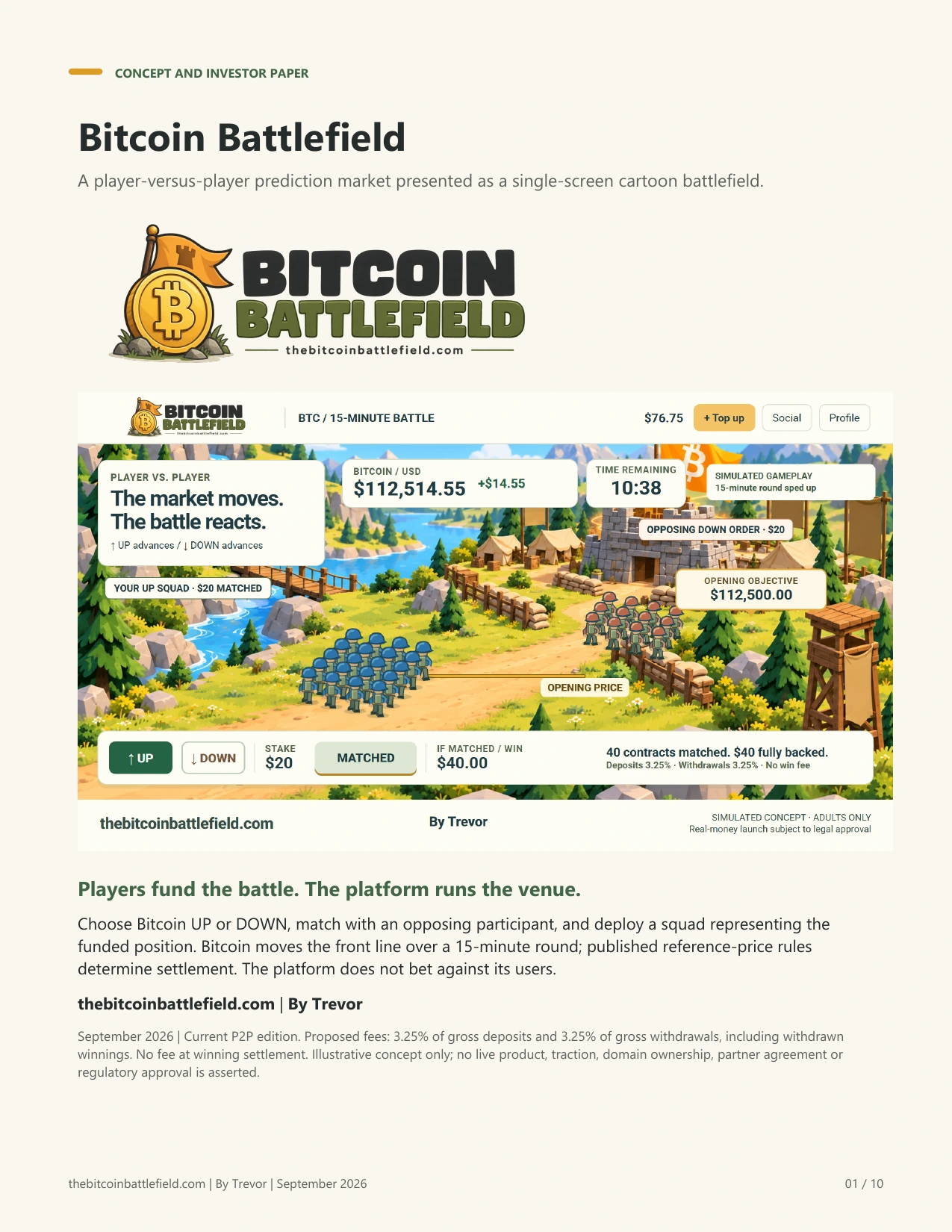
Investor paper page 1: Bitcoin Battlefield. Full page text follows.
Read page 1 as text

Bitcoin Battlefield

A player-versus-player prediction market presented as a single-screen cartoon battlefield.

Players fund the battle. The platform runs the venue.

Choose Bitcoin UP or DOWN, match with an opposing participant, and deploy a squad representing the funded position. Bitcoin moves the front line over a 15-minute round; published reference-price rules determine settlement. The platform does not bet against its users.

thebitcoinbattlefield.com | By Trevor

September 2026 | Current P2P edition. Proposed fees: 3.25% of gross deposits and 3.25% of gross withdrawals, including withdrawn winnings. No fee at winning settlement. Illustrative concept only; no live product, traction, domain ownership, partner agreement or regulatory approval is asserted.

02 / 10   The economic model
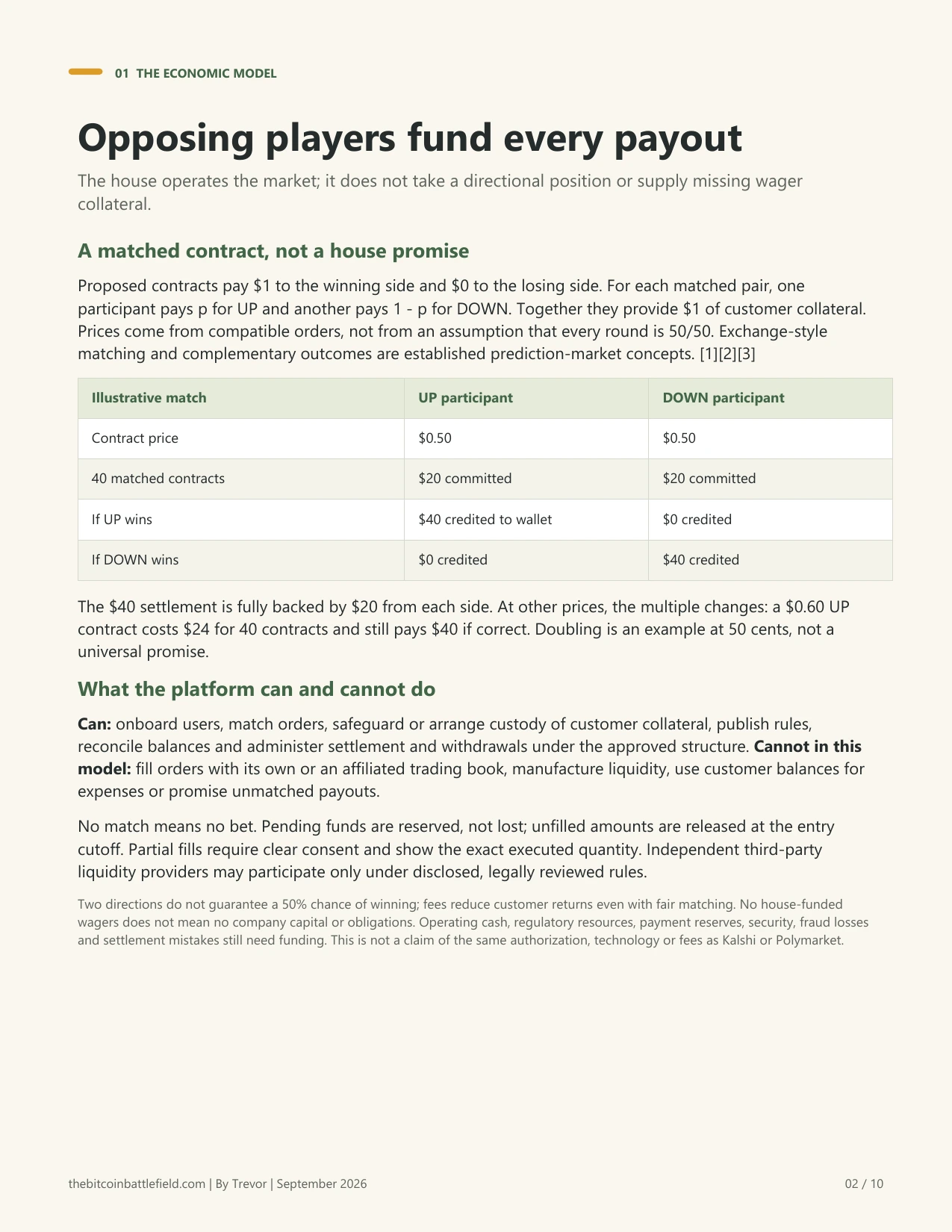
Investor paper page 2: Opposing players fund every payout. Full page text follows.
Read page 2 as text

Opposing players fund every payout

The house operates the market; it does not take a directional position or supply missing wager collateral.

A matched contract, not a house promise

Proposed contracts pay $1 to the winning side and $0 to the losing side. For each matched pair, one participant pays p for UP and another pays 1 - p for DOWN. Together they provide $1 of customer collateral. Prices come from compatible orders, not from an assumption that every round is 50/50. Exchange-style matching and complementary outcomes are established prediction-market concepts. [1][2][3]

Illustrative matchUP participantDOWN participant
Contract price$0.50$0.50
40 matched contracts$20 committed$20 committed
If UP wins$40 credited to wallet$0 credited
If DOWN wins$0 credited$40 credited

The $40 settlement is fully backed by $20 from each side. At other prices, the multiple changes: a $0.60 UP contract costs $24 for 40 contracts and still pays $40 if correct. Doubling is an example at 50 cents, not a universal promise.

What the platform can and cannot do

Can: onboard users, match orders, safeguard or arrange custody of customer collateral, publish rules, reconcile balances and administer settlement and withdrawals under the approved structure. Cannot in this model: fill orders with its own or an affiliated trading book, manufacture liquidity, use customer balances for expenses or promise unmatched payouts.

No match means no bet. Pending funds are reserved, not lost; unfilled amounts are released at the entry cutoff. Partial fills require clear consent and show the exact executed quantity. Independent third-party liquidity providers may participate only under disclosed, legally reviewed rules.

Two directions do not guarantee a 50% chance of winning; fees reduce customer returns even with fair matching. No house-funded wagers does not mean no company capital or obligations. Operating cash, regulatory resources, payment reserves, security, fraud losses and settlement mistakes still need funding. This is not a claim of the same authorization, technology or fees as Kalshi or Polymarket.

03 / 10   The battlefield
Investor paper page 3: The battlefield is the website. Full page text follows.
Read page 3 as text

The battlefield is the website

A bright, restrained cartoon world makes market movement visible without turning the financial rules into a game of chance.

Center stage: blue UP and terracotta DOWN formations occupy the battlefield. The opening-price flag anchors the front line. Price above the opening reference favors UP; below it favors DOWN. Participants are economic counterparties, while the external market decides which prediction is correct.

Persistent top strip: market selector, round ID, opening/current prices, countdown, balance and buttons for top-ups, withdrawals, social and profile. Drawers open over this same scene; closing one returns immediately to the battle.

Persistent bottom dock: UP / DOWN, stake, executable contract price, matched amount, maximum loss and return if correct. Available depth and quote age are shown before confirmation; a displayed midpoint is not a guaranteed fill. [2]

Mobile and spectators: a closer camera and bottom sheets keep the timer and position visible. Watching does not require a wager. Reduced motion, sound controls, readable prices and accessible controls are part of the initial design.

All screens are authored simulations with fictional prices, not a functioning exchange or live feed. Authentication and payment verification may need a provider overlay or redirect back to the same page. Troop counts are illustrative formations; dollar amounts and matched contracts govern.

04 / 10   Choose, match, deploy
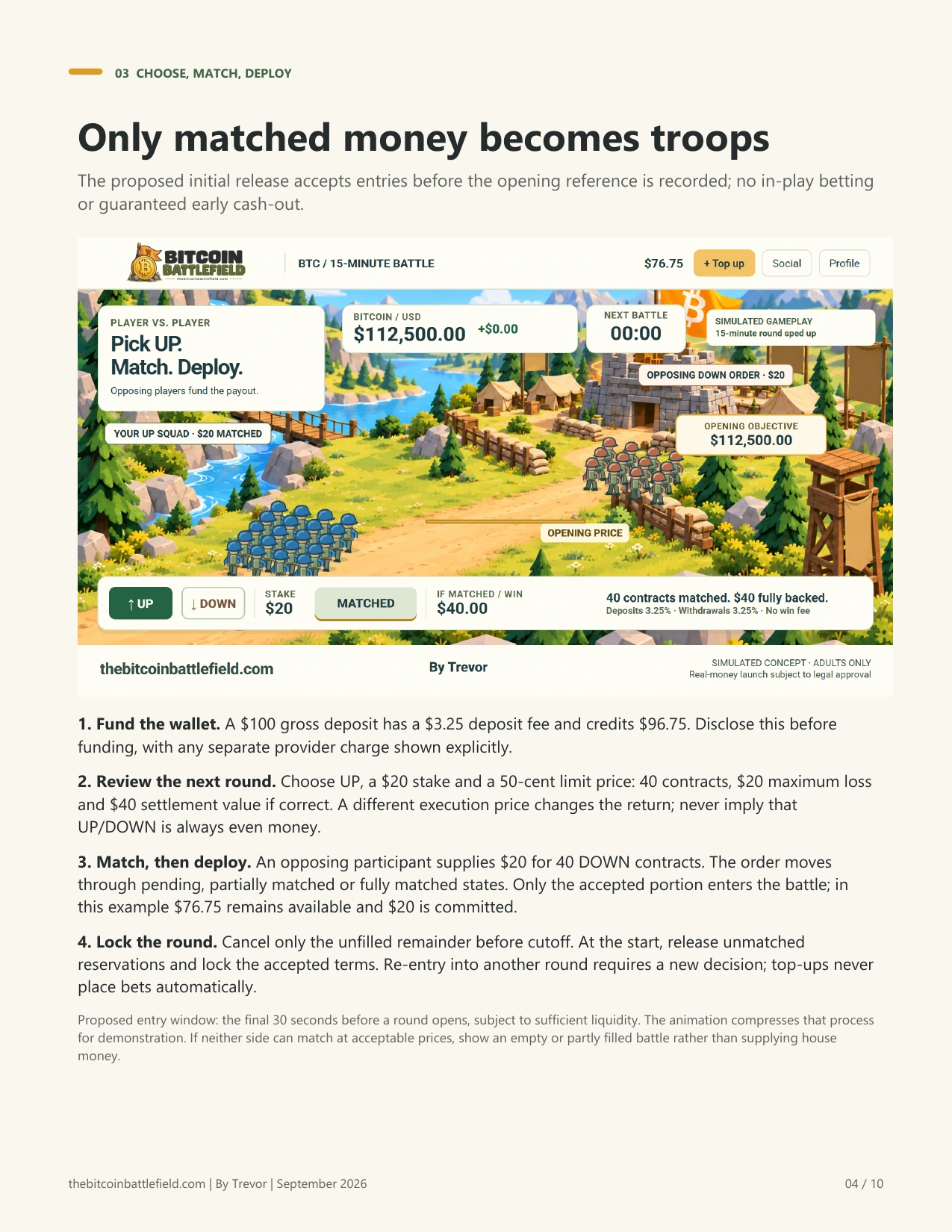
Investor paper page 4: Only matched money becomes troops. Full page text follows.
Read page 4 as text

Only matched money becomes troops

The proposed initial release accepts entries before the opening reference is recorded; no in-play betting or guaranteed early cash-out.

1. Fund the wallet. A $100 gross deposit has a $3.25 deposit fee and credits $96.75. Disclose this before funding, with any separate provider charge shown explicitly.

2. Review the next round. Choose UP, a $20 stake and a 50-cent limit price: 40 contracts, $20 maximum loss and $40 settlement value if correct. A different execution price changes the return; never imply that UP/DOWN is always even money.

3. Match, then deploy. An opposing participant supplies $20 for 40 DOWN contracts. The order moves through pending, partially matched or fully matched states. Only the accepted portion enters the battle; in this example $76.75 remains available and $20 is committed.

4. Lock the round. Cancel only the unfilled remainder before cutoff. At the start, release unmatched reservations and lock the accepted terms. Re-entry into another round requires a new decision; top-ups never place bets automatically.

Proposed entry window: the final 30 seconds before a round opens, subject to sufficient liquidity. The animation compresses that process for demonstration. If neither side can match at acceptable prices, show an empty or partly filled battle rather than supplying house money.

05 / 10   Results & settlement
Investor paper page 5: The market decides. The receipt explains.. Full page text follows.
Read page 5 as text

The market decides. The receipt explains.

Visual drama never changes the contract, the fee or the settlement source.

Live play: price reversals move the two formations. The final ten seconds tighten the camera, not the rules. Crossing the opening line earlier is not a win. Soldiers retreating does not deduct part of a wallet; the outcome is determined at the published end timestamp.

A $20 UP position wins at 50 cents

The example opens at $112,500 and closes at $112,514.20. The winning contract credits $40.00 to the wallet with no settlement/win fee. The available wallet becomes $76.75 + $40 = $116.75. A later $40 gross withdrawal carries a $1.30 withdrawal fee, and the player receives $38.70 externally. The fee applies to the entire withdrawal, including winnings, not only profit.

Receipt and social: the report shows round ID, matched quantity and price, cost, reference timestamps, settlement value, profit/loss and source. A separate withdrawal receipt shows its fee. Profile, battle reports, opt-in moderated chat and spectators open as drawers. Wallet amounts are private by default.

Responsible progression: ranks and cosmetic achievements recognize learning or community activity, not escalating stakes or chasing losses. No misleading near-miss effects, early win celebrations or automatic re-bets.

A tie or valid void returns original matched cost to the wallet under the proposed rules. Previously incurred deposit fees and later withdrawal fees are separate; refund exceptions must be disclosed. A data incident shows settlement pending, not a fabricated result. External reference/oracle processes can delay finality. [4]

06 / 10   The $1 million example
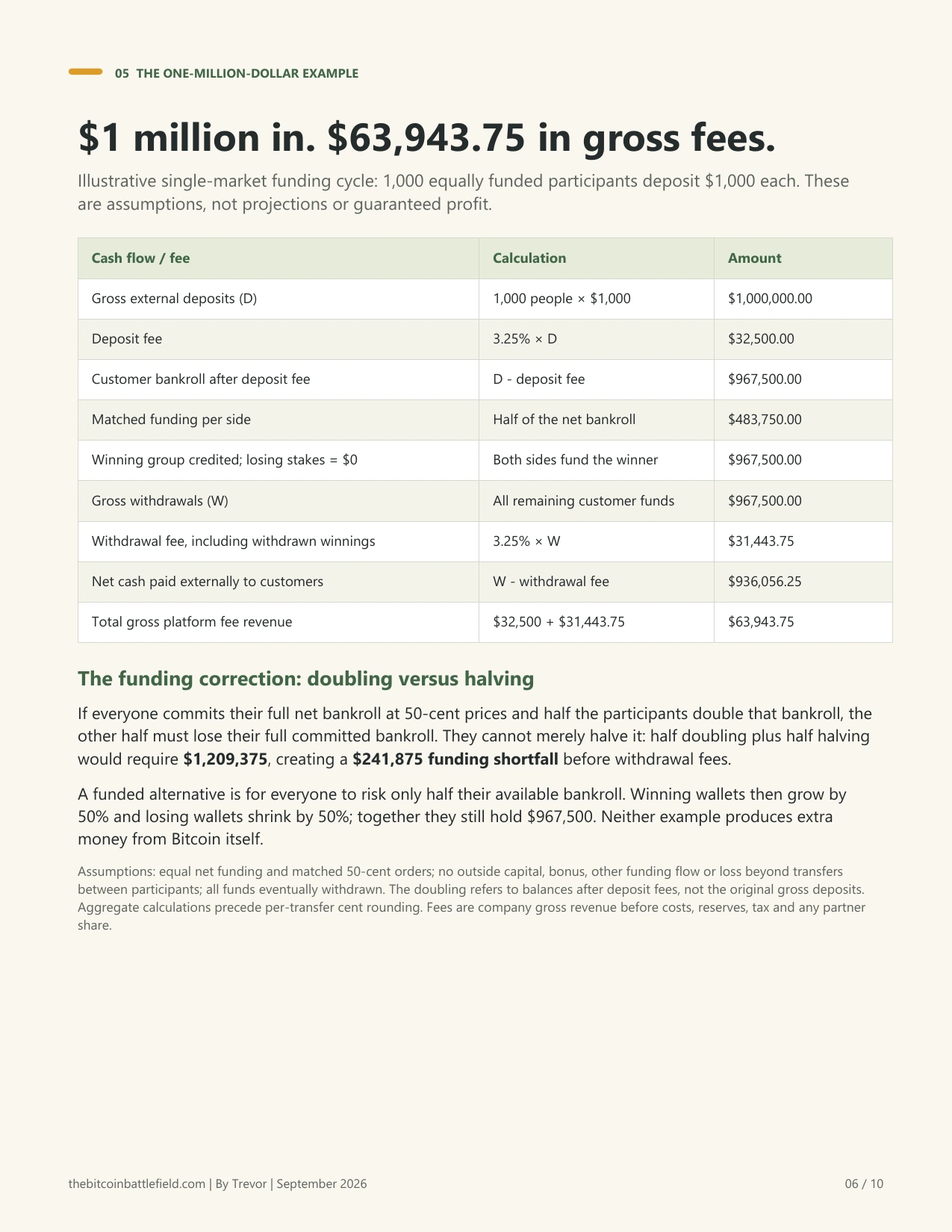
Investor paper page 6: $1 million in. $63,943.75 in gross fees.. Full page text follows.
Read page 6 as text

$1 million in. $63,943.75 in gross fees.

Illustrative single-market funding cycle: 1,000 equally funded participants deposit $1,000 each. These are assumptions, not projections or guaranteed profit.

Cash flow / feeCalculationAmount
Gross external deposits (D)1,000 people × $1,000$1,000,000.00
Deposit fee3.25% × D$32,500.00
Customer bankroll after deposit feeD - deposit fee$967,500.00
Matched funding per sideHalf of the net bankroll$483,750.00
Winning group credited; losing stakes = $0Both sides fund the winner$967,500.00
Gross withdrawals (W)All remaining customer funds$967,500.00
Withdrawal fee, including withdrawn winnings3.25% × W$31,443.75
Net cash paid externally to customersW - withdrawal fee$936,056.25
Total gross platform fee revenue$32,500 + $31,443.75$63,943.75

The funding correction: doubling versus halving

If everyone commits their full net bankroll at 50-cent prices and half the participants double that bankroll, the other half must lose their full committed bankroll. They cannot merely halve it: half doubling plus half halving would require $1,209,375, creating a $241,875 funding shortfall before withdrawal fees.

A funded alternative is for everyone to risk only half their available bankroll. Winning wallets then grow by 50% and losing wallets shrink by 50%; together they still hold $967,500. Neither example produces extra money from Bitcoin itself.

Assumptions: equal net funding and matched 50-cent orders; no outside capital, bonus, other funding flow or loss beyond transfers between participants; all funds eventually withdrawn. The doubling refers to balances after deposit fees, not the original gross deposits. Aggregate calculations precede per-transfer cent rounding. Fees are company gross revenue before costs, reserves, tax and any partner share.

07 / 10   Business model
Investor paper page 7: Revenue follows money in and out. Full page text follows.
Read page 7 as text

Revenue follows money in and out

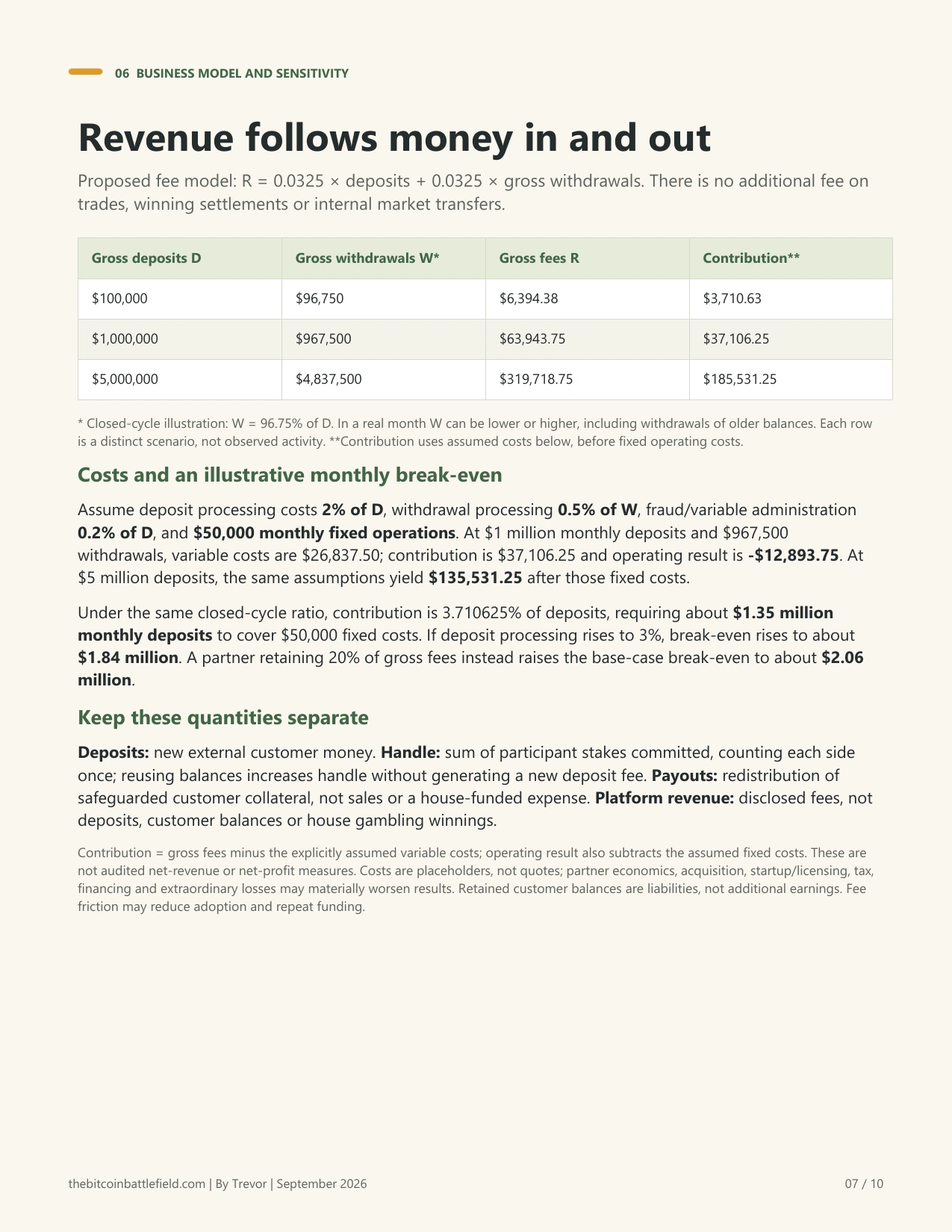
Proposed fee model: R = 0.0325 × deposits + 0.0325 × gross withdrawals. There is no additional fee on trades, winning settlements or internal market transfers.

Gross deposits DGross withdrawals W*Gross fees RContribution**
$100,000$96,750$6,394.38$3,710.63
$1,000,000$967,500$63,943.75$37,106.25
$5,000,000$4,837,500$319,718.75$185,531.25

* Closed-cycle illustration: W = 96.75% of D. In a real month W can be lower or higher, including withdrawals of older balances. Each row is a distinct scenario, not observed activity. **Contribution uses assumed costs below, before fixed operating costs.

Costs and an illustrative monthly break-even

Assume deposit processing costs 2% of D, withdrawal processing 0.5% of W, fraud/variable administration 0.2% of D, and $50,000 monthly fixed operations. At $1 million monthly deposits and $967,500 withdrawals, variable costs are $26,837.50; contribution is $37,106.25 and operating result is -$12,893.75. At $5 million deposits, the same assumptions yield $135,531.25 after those fixed costs.

Under the same closed-cycle ratio, contribution is 3.710625% of deposits, requiring about $1.35 million monthly deposits to cover $50,000 fixed costs. If deposit processing rises to 3%, break-even rises to about $1.84 million. A partner retaining 20% of gross fees instead raises the base-case break-even to about $2.06 million.

Keep these quantities separate

Deposits: new external customer money. Handle: sum of participant stakes committed, counting each side once; reusing balances increases handle without generating a new deposit fee. Payouts: redistribution of safeguarded customer collateral, not sales or a house-funded expense. Platform revenue: disclosed fees, not deposits, customer balances or house gambling winnings.

Contribution = gross fees minus the explicitly assumed variable costs; operating result also subtracts the assumed fixed costs. These are not audited net-revenue or net-profit measures. Costs are placeholders, not quotes; partner economics, acquisition, startup/licensing, tax, financing and extraordinary losses may materially worsen results. Retained customer balances are liabilities, not additional earnings. Fee friction may reduce adoption and repeat funding.

08 / 10   More markets
Investor paper page 8: Bitcoin first. More battlefields later.. Full page text follows.
Read page 8 as text

Bitcoin first. More battlefields later.

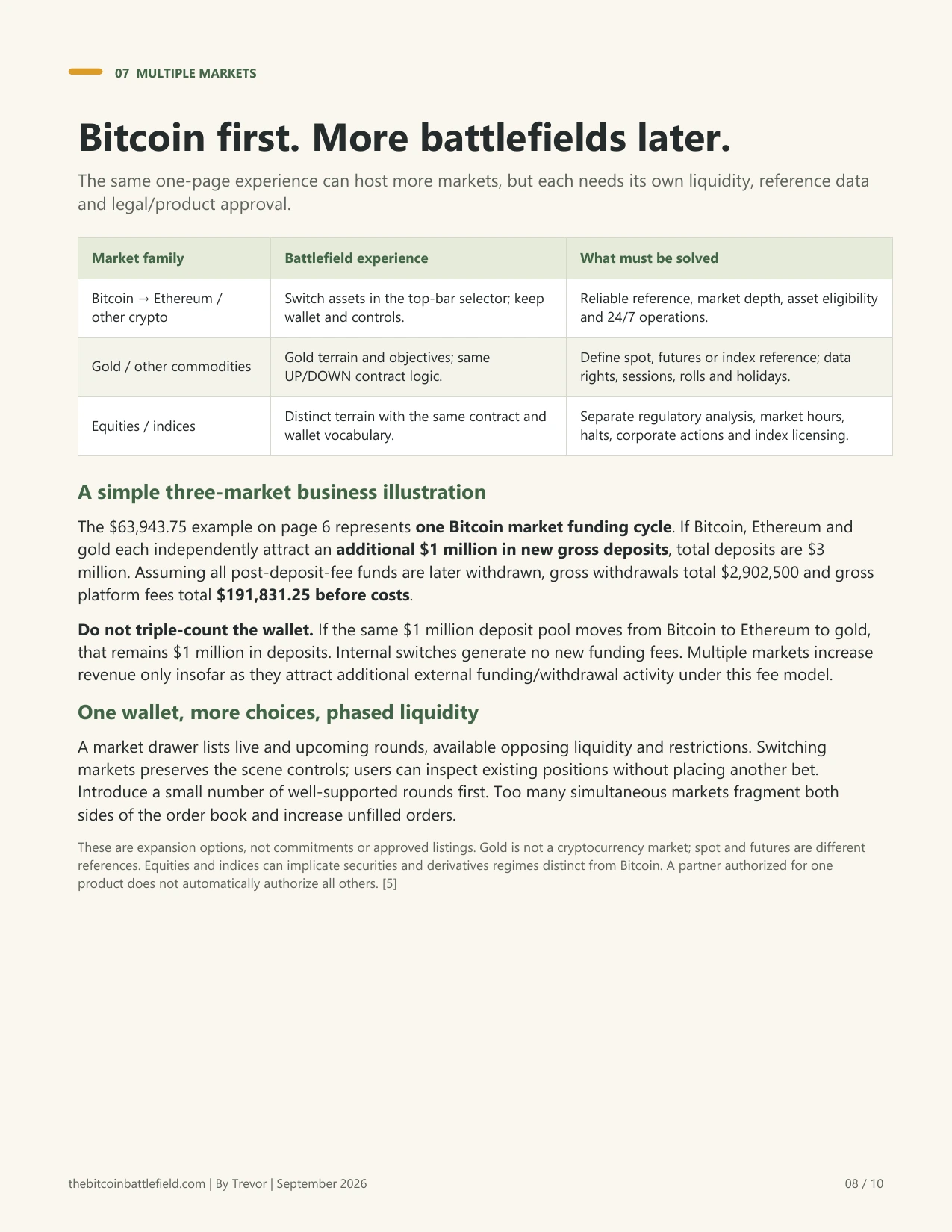
The same one-page experience can host more markets, but each needs its own liquidity, reference data and legal/product approval.

Market familyBattlefield experienceWhat must be solved
Bitcoin → Ethereum / other cryptoSwitch assets in the top-bar selector; keep wallet and controls.Reliable reference, market depth, asset eligibility and 24/7 operations.
Gold / other commoditiesGold terrain and objectives; same UP/DOWN contract logic.Define spot, futures or index reference; data rights, sessions, rolls and holidays.
Equities / indicesDistinct terrain with the same contract and wallet vocabulary.Separate regulatory analysis, market hours, halts, corporate actions and index licensing.

A simple three-market business illustration

The $63,943.75 example on page 6 represents one Bitcoin market funding cycle. If Bitcoin, Ethereum and gold each independently attract an additional $1 million in new gross deposits, total deposits are $3 million. Assuming all post-deposit-fee funds are later withdrawn, gross withdrawals total $2,902,500 and gross platform fees total $191,831.25 before costs.

Do not triple-count the wallet. If the same $1 million deposit pool moves from Bitcoin to Ethereum to gold, that remains $1 million in deposits. Internal switches generate no new funding fees. Multiple markets increase revenue only insofar as they attract additional external funding/withdrawal activity under this fee model.

One wallet, more choices, phased liquidity

A market drawer lists live and upcoming rounds, available opposing liquidity and restrictions. Switching markets preserves the scene controls; users can inspect existing positions without placing another bet. Introduce a small number of well-supported rounds first. Too many simultaneous markets fragment both sides of the order book and increase unfilled orders.

These are expansion options, not commitments or approved listings. Gold is not a cryptocurrency market; spot and futures are different references. Equities and indices can implicate securities and derivatives regimes distinct from Bitcoin. A partner authorized for one product does not automatically authorize all others. [5]

09 / 10   Safety & settlement
Investor paper page 9: No house bets does not mean no regulation. Full page text follows.
Read page 9 as text

No house bets does not mean no regulation

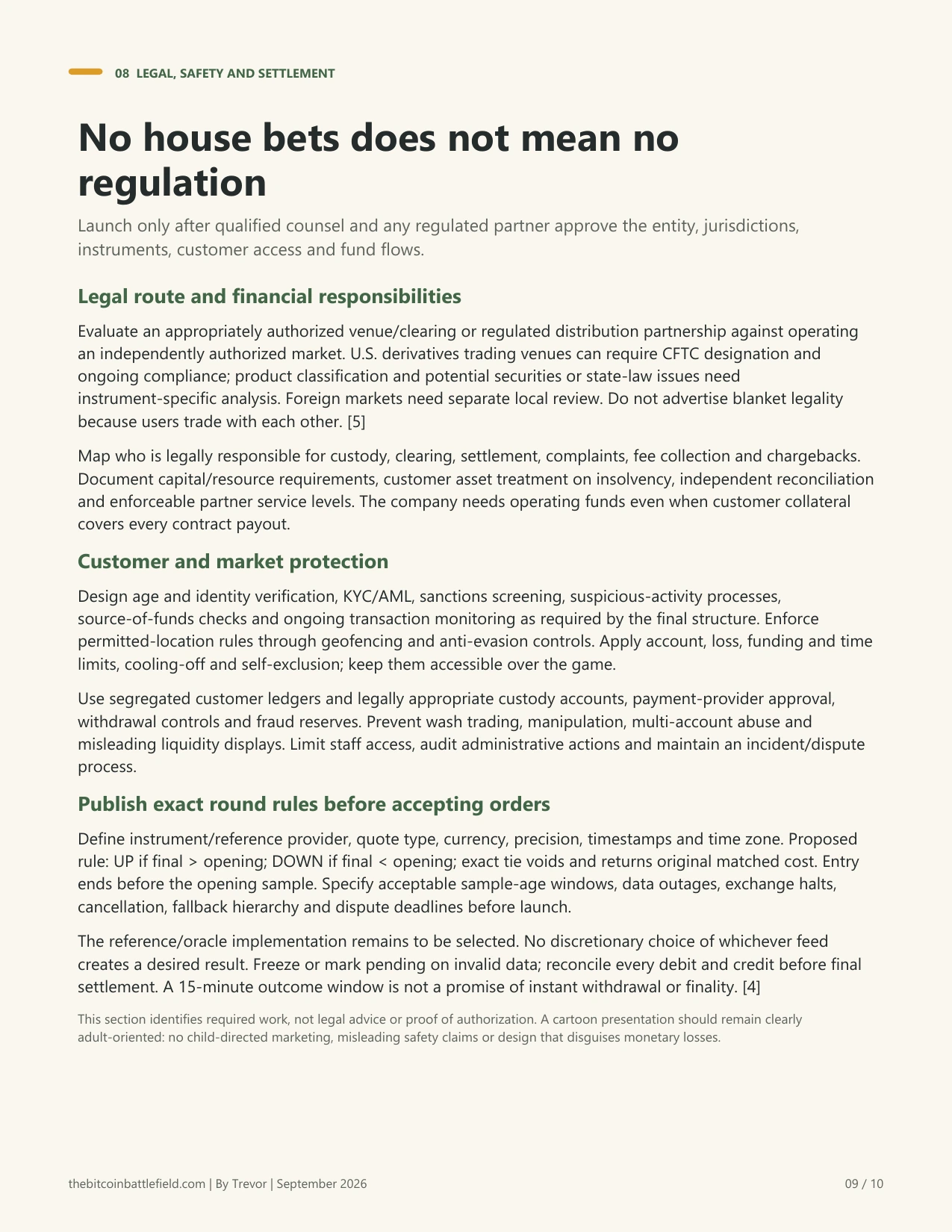
Launch only after qualified counsel and any regulated partner approve the entity, jurisdictions, instruments, customer access and fund flows.

Legal route and financial responsibilities

Evaluate an appropriately authorized venue/clearing or regulated distribution partnership against operating an independently authorized market. U.S. derivatives trading venues can require CFTC designation and ongoing compliance; product classification and potential securities or state-law issues need instrument-specific analysis. Foreign markets need separate local review. Do not advertise blanket legality because users trade with each other. [5]

Map who is legally responsible for custody, clearing, settlement, complaints, fee collection and chargebacks. Document capital/resource requirements, customer asset treatment on insolvency, independent reconciliation and enforceable partner service levels. The company needs operating funds even when customer collateral covers every contract payout.

Customer and market protection

Design age and identity verification, KYC/AML, sanctions screening, suspicious-activity processes, source-of-funds checks and ongoing transaction monitoring as required by the final structure. Enforce permitted-location rules through geofencing and anti-evasion controls. Apply account, loss, funding and time limits, cooling-off and self-exclusion; keep them accessible over the game.

Use segregated customer ledgers and legally appropriate custody accounts, payment-provider approval, withdrawal controls and fraud reserves. Prevent wash trading, manipulation, multi-account abuse and misleading liquidity displays. Limit staff access, audit administrative actions and maintain an incident/dispute process.

Publish exact round rules before accepting orders

Define instrument/reference provider, quote type, currency, precision, timestamps and time zone. Proposed rule: UP if final > opening; DOWN if final < opening; exact tie voids and returns original matched cost. Entry ends before the opening sample. Specify acceptable sample-age windows, data outages, exchange halts, cancellation, fallback hierarchy and dispute deadlines before launch.

The reference/oracle implementation remains to be selected. No discretionary choice of whichever feed creates a desired result. Freeze or mark pending on invalid data; reconcile every debit and credit before final settlement. A 15-minute outcome window is not a promise of instant withdrawal or finality. [4]

This section identifies required work, not legal advice or proof of authorization. A cartoon presentation should remain clearly adult-oriented: no child-directed marketing, misleading safety claims or design that disguises monetary losses.


10 / 10   The plan & references
Investor paper page 10: Build evidence before scaling. Full page text follows.
Read page 10 as text

Build evidence before scaling

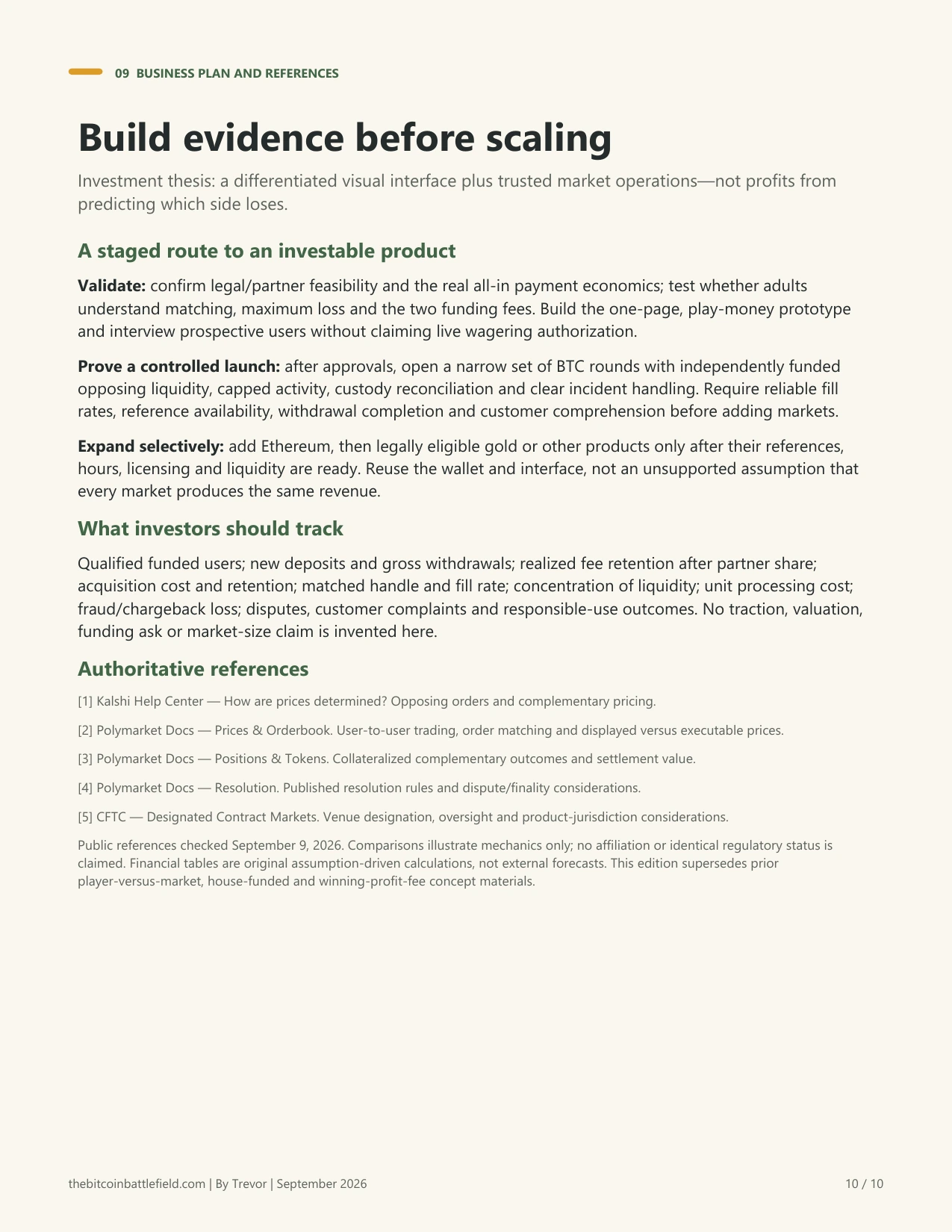
Investment thesis: a differentiated visual interface plus trusted market operations—not profits from predicting which side loses.

A staged route to an investable product

Validate: confirm legal/partner feasibility and the real all-in payment economics; test whether adults understand matching, maximum loss and the two funding fees. Build the one-page, play-money prototype and interview prospective users without claiming live wagering authorization.

Prove a controlled launch: after approvals, open a narrow set of BTC rounds with independently funded opposing liquidity, capped activity, custody reconciliation and clear incident handling. Require reliable fill rates, reference availability, withdrawal completion and customer comprehension before adding markets.

Expand selectively: add Ethereum, then legally eligible gold or other products only after their references, hours, licensing and liquidity are ready. Reuse the wallet and interface, not an unsupported assumption that every market produces the same revenue.

What investors should track

Qualified funded users; new deposits and gross withdrawals; realized fee retention after partner share; acquisition cost and retention; matched handle and fill rate; concentration of liquidity; unit processing cost; fraud/chargeback loss; disputes, customer complaints and responsible-use outcomes. No traction, valuation, funding ask or market-size claim is invented here.

Authoritative references

[1] Kalshi Help Center — How are prices determined? Opposing orders and complementary pricing.

[2] Polymarket Docs — Prices &amp; Orderbook. User-to-user trading, order matching and displayed versus executable prices.

[3] Polymarket Docs — Positions &amp; Tokens. Collateralized complementary outcomes and settlement value.

[4] Polymarket Docs — Resolution. Published resolution rules and dispute/finality considerations.

[5] CFTC — Designated Contract Markets. Venue designation, oversight and product-jurisdiction considerations.

Public references checked September 9, 2026. Comparisons illustrate mechanics only; no affiliation or identical regulatory status is claimed. Financial tables are original assumption-driven calculations, not external forecasts. This edition supersedes prior player-versus-market, house-funded and winning-profit-fee concept materials.

An invitation from the founder

Help build the platform
behind the battlefields.

I'm looking for investors and strategic partners to help turn this vision into a working business: validate the market, build the first experience, and establish the foundation for expansion.

Product & engineeringMarket & partner validationLaunch readiness
trevor@trevormillett.com

Early-stage concept. Financial examples are illustrative and before costs, not guaranteed returns. Launch is subject to validation and required approvals.